

Researchers at United Arab Emirates University (UAEU) have developed a US patent that presents a sustainable method for concrete production using waste paper ash as a partial substitute for cement, combined with carbon dioxide curing technology, contributing to lower carbon emissions and supporting circular economy practices in the construction sector.
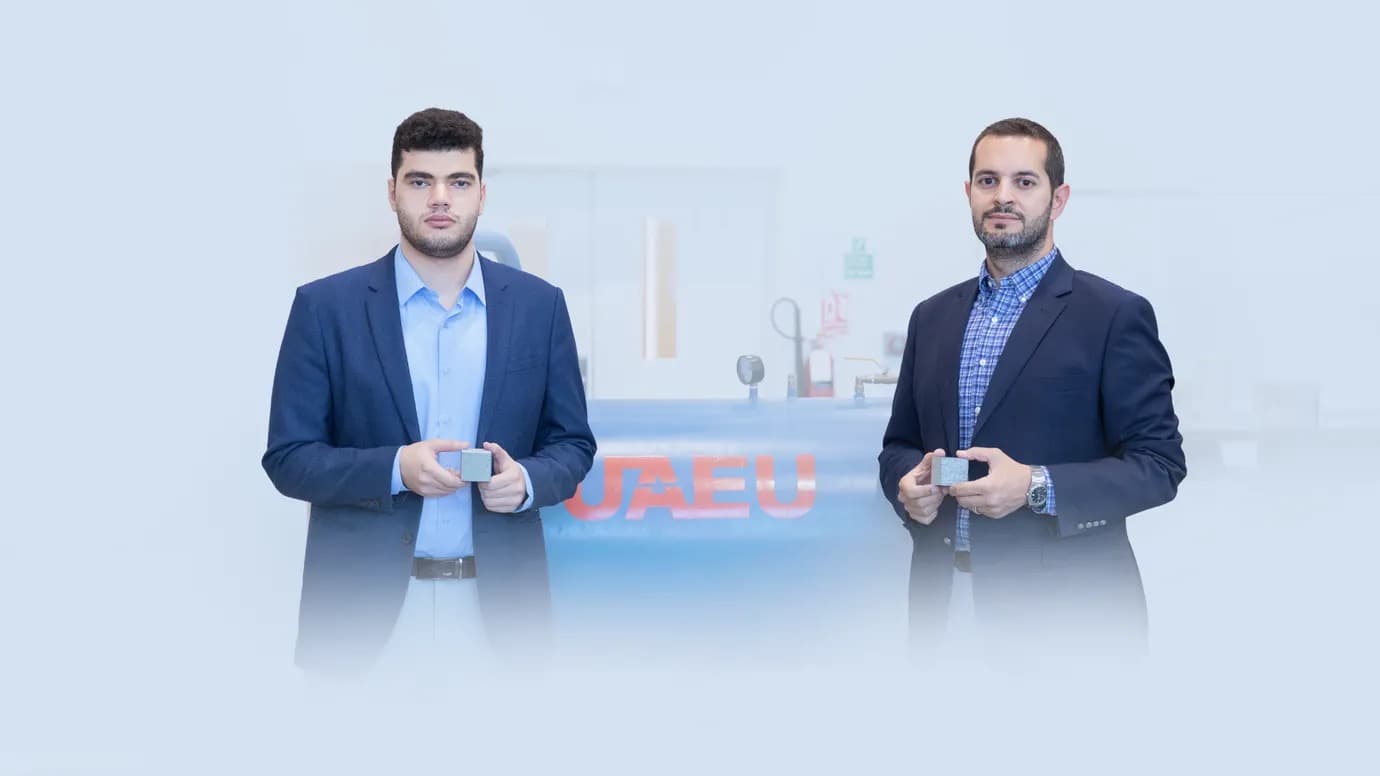
The patent was developed by a research team consisting of Professor Hilal El-Hassan and Professor Tamer El Maaddawy from the College of Engineering, Eng. Karim Hassan, a master's student at the university, and Dr. Jad Bawab, a UAEU alumnus. The team worked on developing an innovative solution that integrates the recycling of waste paper ash with carbon dioxide curing techniques to produce sustainable concrete with a lower environmental impact.
The research aims to address two major environmental challenges: the high emissions associated with cement production and the disposal of waste paper ash generated from paper-related industries. The technology relies on replacing part of conventional cement with waste paper ash, reducing dependence on cement while creating a productive use for an industrial by-product.
"The innovation reflects the importance of developing sustainable engineering solutions that help reduce the environmental impact of the construction sector through the innovative utilisation of industrial waste to lower emissions and enhance resource efficiency."
The technology also involves exposing concrete to carbon dioxide under controlled curing conditions after casting, helping improve the development of mechanical strength while binding part of the gas within the concrete. The study evaluated several variables, including waste paper ash replacement levels, water-to-binder ratios, binder-to-aggregate ratios, and carbon dioxide exposure duration.
The findings demonstrated the successful use of waste paper ash as a partial cement replacement, with mixtures containing the material showing high carbon dioxide storage potential while maintaining suitable mechanical and durability-related properties, including compressive strength and water absorption. The study also showed that moderate cement replacement levels, particularly around 10 per cent, achieved a promising balance between performance and environmental sustainability.
The significance of the innovation lies in integrating industrial waste valorisation, cement reduction, and carbon dioxide utilisation within the curing process, supporting the development of more sustainable construction materials. Potential applications of the technology include precast concrete units, concrete blocks, paving units, and other cement-based components manufactured under controlled curing conditions.